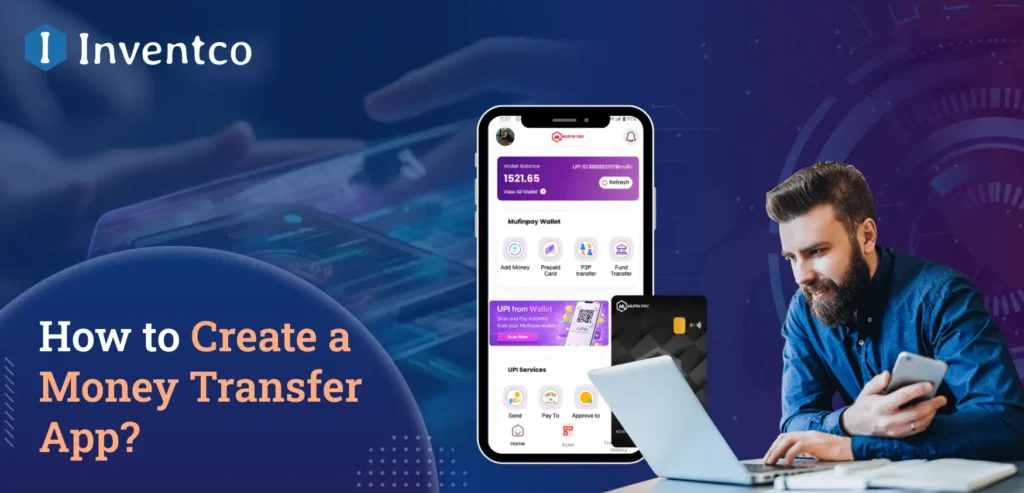
Every day, billions of dollars move across borders, between bank accounts, and through mobile wallets. Yet for many founders and investors stepping into the fintech space, the core question remains surprisingly complex: how do you actually build a money transfer app that people trust, regulators approve, and the market rewards?
The answer is not as simple as hiring a development team and launching an app. Money transfer app development sits at the intersection of financial regulation, security engineering, UX design, and business strategy. Miss any one of these, and you are not just looking at a failed product; you are looking at potential legal exposure and reputational damage.
This guide is written specifically for founders and investors who want a clear, authoritative roadmap. Whether you are planning to create a peer-to-peer money transfer app, build a cross-border remittance platform, or develop a white-label solution for businesses, this guide covers the full journey, from market opportunity and feature planning to development steps, cost estimation, and compliance. Let us start where every smart investment decision should: with the data.
Key Takeaways
- The global digital remittance market is projected to exceed $1.08 trillion by 2032, presenting a massive entry window.
- Money transfer app development requires compliance with AML, KYC, PCI DSS, and GDPR before launch.
- Core features like real-time transfers, multi-currency support, and biometric login are non-negotiables for market entry.
- An MVP can be built in 3 to 6 months, a full-featured platform typically takes 9 to 18 months.
- Development costs range from $10,000 for an MVP to $100,000+ for an advanced, scalable solution.
- Hiring a specialized fintech development partner significantly reduces time-to-market and compliance risk.
- P2P, international, business, and crypto transfer apps each serve distinct user needs and monetization models.
Market Stats and Data
Before you commit capital and engineering resources to build a money transfer app, the market data should give you strong conviction. The numbers tell a compelling story about why this vertical is attracting serious fintech investment globally.
- According to Grand View Research, the global digital remittance market reached $44.68 billion in 2024, driven by mobile adoption and cross-border financial digitization.
- The market is projected to exceed $1.08 trillion by 2032, reflecting explosive demand for faster, cheaper, and borderless financial transactions.
- The industry is expected to grow at a CAGR of approximately 22.5% between 2024 and 2032, signaling sustained global fintech expansion.
- According to McKinsey & Company report the cross-border B2B payments market is expected to exceed $35 trillion by 2030, driven by globalization and the growth of digital transaction infrastructure.
- Approximately 1.4 billion people globally remain unbanked, representing a significant opportunity for mobile money transfer apps to drive financial inclusion.
These figures are not just interesting statistics. They represent underserved markets, growing user expectations, and a clear commercial opportunity for founders who build the right product at the right time. The unbanked population of 1.4 billion people alone represents a frontier that mobile-first money transfer apps are uniquely positioned to address.
Why is Money Transfer App Development in Demand?
The demand for money transfer app development is not just another app development trend, it is a structural shift in how people and businesses manage financial transactions. Several converging forces are driving this growth, and understanding them is essential for founders making investment decisions.
1. The Death of the Bank Branch
Millennials and Gen Z consumers are less likely to use traditional bank branches. No one enjoys wasting time waiting in line at a bank and losing money to a bank wire transfer. Fintech apps like Wise, Revolut, and Cash app have completely shifted consumers’ expectations for service from traditional banks. There is no question that money transfer apps are not competing against traditional banks, but rather against customers’ expectations for seamless smartphone use.
2. Global Migration and Remittances
International remittance transactions are the most ubiquitous use case for money transfer apps, and each day grows at an ever increasing rate. The World Bank says that in 2023, total remittances to low- and middle-income countries were $669 billion. Money transfer apps that facilitate low- or no-cost transactions in minutes are services that positively impact millions of families.
3. The Rise of the Gig Economy
Workers in the gig economy, including freelancers, contractors, and remote workers, need agile, instant, and cross-border payment systems, as traditional payment systems do not accommodate them. Real-time payment systems and multi-currency wallets are now integrated with Upwork and Fiverr. From a business perspective, developing payment systems for these types of freelancers offers lucrative opportunities.
4. Embedded Finance and API-First Infrastructure
There is a mature fintech infrastructure that allows easy development of payment systems. With the advancement and refinement of open banking systems and similar systems, integrated payments, and banking-as-a-service, embedded fintech solutions have significantly shortened the time-to-market for payment systems. What was previously a legacy banking requirement of a full license and a hundred-man development team can now be reduced to a few charging APIs.
5. Regulatory Modernization
Many countries in Europe, the UK, the US, and SE Asia have introduced regulations that provide greater clarity on the licensing and legislative frameworks applicable to FinTech. This has significantly reduced the complexity for new businesses competing with legacy banks and increased the market opportunity to create viable payment systems.
Types of Money Transfer Apps
Money transfer applications offer various services based on users and business models. Before starting a development process, it is essential to understand what type of money-transfer application you are developing. This is important as there will be different technical demands, legal obligations, and ways to generate income.
1. Peer-to-Peer (P2P) Money Transfer Apps
P2P transfer applications enable users to send money to each other, typically within the same country. Well-known examples include Venmo, Cash App, and Google Pay. In P2P transfer applications, developers should expect cash transfers to be as seamless as possible and should also include social features such as split billing. Monetization is commonly achieved through transaction fees or a premium subscription model.
2. International Money Transfer Apps
Such applications enable money transfer services across multiple countries; in these cases, customers benefit from better exchange rates and lower fees than those offered by traditional banks. Remitly and Wise Transfer (formerly TransferWise) are players in this niche. Application developers in International Transactions must provide multi-currency wallets and real-time Foreign Exchange services, and ensure adequate compliance with International Anti-Money Laundering (AML) and know-your-customer (KYC) regulations. This is one of the most challenging yet lucrative niches in Financial Services Technology (FinTech).
3. Business-to-Business (B2B) Payment Apps
In Business-to-Business (B2B) Money Transfer applications, software development also focuses on how a business executes payments in the form of employees’ wages (Payroll), payments to vendors, and other payments within the business, also referred to as treasury operations. Such solutions need to include payment systems with high transaction limits, integration with Enterprise Resource Planning (ERP) Systems, adequate auditing, and a role-based access matrix. The average transaction value is much higher than that of other application types, which makes this a profitable application type.
4. Mobile Wallet Apps
Paytm, Google Wallet, Apple, and others have mobile payment systems integrated with NFC for in-store payments, peer-to-peer transfers, and more. They can also manage payment cards and store money in a payment account. These applications have more sophisticated banking infrastructure and often involve large funding and well-established fintech companies.
5. Crypto-Based Transfer Apps
The apps for money transfer services are built on the blockchain and use either cryptocurrency or stablecoin to settle transfers. They do not require international payment services to use the SWIFT payment system, thus providing fast, low-cost transfers. This ecosystem is designed to meet the needs of the unbanked population. There is still a need for greater regulatory certainty, however, this sector is experiencing the most rapid growth in the development of money transfer systems.
6. Neobank and Super-App Transfers
Emerging global neobanks and apps like Grab or WeChat Pay are offering money transfers as part of a wider financial ecosystem. Bill payment, money lending, investment, insurance, and, of course, money transfer are among the features available. This is one of the most capital-intensive areas of development in the fintech industry, though in the long term, the network effect and monetization potential are extremely high.
Key Features to Include in a Money Transfer App
Feature selection is one of the most consequential decisions in money transfer app development. Over-building at launch slows time-to-market and burns capital. Under-building erodes trust and user retention. Here is a structured breakdown of mobile app features that every competitive app must include at launch and what you should plan for in subsequent releases.
Core Features (Must-Have at Launch)
1. User Registration & KYC Verification
An onboarding flow with identity verification and KYC is created to enable and legally process user transactions. To avoid loss, integrate identity verification from Onfido, Jumio, or Persona to ensure users’ identities are verified without drop-off in the onboarding process.
2. Real-Time Money Transfers
An instant transfer should not be a goal; it should be a minimum if you wish to stay competitive. Ordering transfer products is about reliable transactions. Real-time transfers should be combined with smart routing for other transfers to ensure the highest level of reliability.
3. Multi-Currency Wallet & FX Rates
International transfers require multi-currency. Real-time transparent exchange rates should be made available to users. Utilise Open Exchange Rates and CurrencyLayer to provide real-time FX data, and coupled with a small margin on the mid-market rate, you will build trust.
4. Transaction History & Notifications
Trust is built by accountability and transparency. Push alerts and emails should be interactive and should provide answers to the user. Every detail should be evident: the amount sent, the transfer status, the fees, the value, the arrival time, and the confirmation. Many jurisdictions require legal retention for user data.
5. Bank Account & Card Linking
For customers to add bank accounts, debit cards, or credit cards as funding sources, it should be straightforward. Integrate with Plaid, TrueLayer, or utilize Open Banking APIs. Ensure card payment data is handled in compliance with PCI DSS. Enable seamless payment experiences with one-time and saved payment methods.
Advanced Features (Phase 2 and Beyond)
1. Biometric Authentication & Fraud Detection
Account takeover fraud is significantly reduced with advanced security features such as face ID, fingerprint login, and behavioral biometrics (such as typing cadence and device orientation). Biometric login can be combined with machine-learning transaction monitoring to detect fraud in real time. BioCatch and Sardine provide turnkey behavioral fraud detection for money movement.
2. Scheduled & Recurring Transfers
Users who can create scheduled, automatic, and recurring money transfers (e.g., weekly, monthly) will engage with the app in the long term. This is especially valuable for remittance users, as setting up transfers to their home countries becomes easier and automatic. It also creates a subscription revenue stream for premium transfers.
3. In-App Currency Exchange
Users can easily convert currencies with competitive rates directly in the app. This feature is also a treasury management tool, as users can hold multi-currency balances, execute forward contracts, and set rate alerts. It is highly profitable for the app owner to position the app as a comprehensive treasury tool rather than just a transfer utility.
4. AI-Powered Spend Analytics & Insights
An analytics feature that provides spending insights elevates a transactional app to a financial management tool. AI can be leveraged to classify spending, detect behavioral patterns, and provide tailored recommendations. This leads to increased time spent in the app, better retention, and increased sales of higher-tiered accounts or additional financial services.
5. White-Label API for Business Clients
A white-label or embedded finance API layer can be offered so that businesses can integrate your transfer infrastructure into their own offerings. This B2B revenue stream is exceptionally scalable and enables lower customer acquisition costs than B2C. Additionally, it forms sticky, long-term contract relationships. For money transfer platforms that have validated their core technologies, this is the next logical step.
How to Develop a Money Transfer App: Step-by-Step
decision impacts security, compliance, and scalability. Rushing any stage can introduce technical debt, regulatory exposure, and long-term trust issues that are difficult to fix post-launch.
At Inventco, we follow a proven, step-by-step app development process customized for fintech app solutions. This approach ensures that every layer, from business logic and compliance architecture to user experience and transaction security, is aligned with real-world financial requirements and built for sustainable growth.
Step 1: Define Your Business Model and Target Market
Every successful money transfer app starts with a clearly defined business model and target audience. Decide how your app will generate revenue, transaction fees, FX margins, subscriptions, or value-added services. At the same time, identify your core users, whether P2P customers, international senders, freelancers, or businesses. These decisions directly shape your product architecture, compliance requirements, and feature priorities. Skipping this step often leads to building technically sound solutions that fail to meet real market needs.
Step 2: Conduct Market Research and Competitive Analysis
A detailed analysis of competitors like Wise, Remitly, and PayPal helps identify market gaps and opportunities. Study their features, monetization models, and user feedback to uncover pain points. Combine this with direct user research to understand real-world challenges and expectations. This step ensures your product is positioned strategically, solving meaningful problems while aligning with current fintech trends and user behavior.
Step 3: Define Compliance and Licensing Requirements
This is the step that many non-fintech founders underestimate. Depending on your jurisdiction and the corridors you intend to serve, you may need a Money Transmitter License (MTL) in the US, an Electronic Money Institution (EMI) license in the EU, or equivalent regulatory approvals in other markets. Engage a fintech regulatory attorney early. Compliance is not just a legal checkbox, it is a competitive moat. Apps that earn regulatory trust attract users and institutional partners that others cannot.
Step 4: Create Wireframes and App Prototype
Before writing a single line of code, translate your product vision into wireframes and an interactive prototype. Wireframes define the information architecture and user flows. A clickable mobile app prototype allows you to validate the experience with real users and investors before committing development resources. Tools like Figma or Sketch are standard for this phase. The goal is to identify UX problems early, when changes cost hours, not weeks. Investing in solid app wireframing at this stage pays dividends throughout the entire development lifecycle.
Step 5: Select Your Technology Stack
Your technology stack decisions will affect performance, scalability, security, and hiring. For mobile, the most common approaches are React Native (cross-platform) for faster time-to-market or Swift/Kotlin (native) for maximum performance. On the backend, Node.js, Python, or Go are popular for high-throughput financial systems. For databases, PostgreSQL combined with Redis for caching is a proven pattern. Cloud infrastructure on AWS or GCP provides the scalability and compliance tooling that financial applications demand. Thinking through your mobile app technology stack at this stage ensures architectural decisions align with your long-term product roadmap.
Step 6: Build the MVP
An MVP is not a stripped-down version of your vision, it is the minimum set of features that delivers genuine value to a specific user segment. For a money transfer app, this typically means: onboarding with KYC, a single transfer flow (domestic or one currency corridor), basic transaction history, and push notifications. Launch your MVP to a controlled cohort of users. Measure completion rates, transfer success rates, and support ticket themes obsessively. An MVP mobile app approach lets you validate product-market fit before scaling your development investment.
Step 7: Conduct Security Audits and Penetration Testing
Financial applications are primary targets for sophisticated cyberattacks. Before any public launch, commission independent security audits covering your API layer, data storage practices, authentication mechanisms, and third-party integrations. Penetration testing by a certified firm will surface exploitable vulnerabilities before bad actors do. Implement OWASP Mobile Security Guidelines and ensure end-to-end encryption for all transaction data in transit and at rest. This step is non-negotiable and should be budgeted as a fixed line item in your app development cost. Review mobile app security best practices to build a secure architecture from the ground up.
Step 8: Mobile App Testing
Comprehensive testing across devices, operating systems, network conditions, and edge cases is critical for a financial application that carries real monetary consequences. Your testing protocol should include unit testing, integration testing, load testing (simulating peak transaction volumes), and user acceptance testing (UAT) with a representative sample of your target users. Do not launch a money transfer app that has not been stress-tested at scale. Establishing a rigorous mobile app testing process ensures your platform can reliably handle real-world transaction volumes and failure scenarios.
Step 9: Launch, Monitor, and Iterate
A successful launch is not the end of the process, it is the beginning. Post-launch, implement real-time monitoring of transaction success rates, latency, and fraud signals. Establish a rapid response protocol for payment failures or security incidents. Use your analytics data to prioritize the next development sprint, typically by focusing on advanced features such as scheduled transfers, loyalty programs, or business accounts. Plan your App Store Optimization strategy early to improve discoverability and organic user acquisition. The best fintech apps in the world maintain continuous investment in their mobile app maintenance infrastructure to sustain performance and compliance as they scale.
How to Create a Money Transfer App: Build vs. Hire
Money transfer apps are a thriving business opportunity. One of the first and most crucial decisions you’ll need to make would be whether to create your own in-house development team or to partner with a fintech app development company. While there is no definitive answer to this question, several factors could influence your decision.
In-House Team
Self-funded startups with a viable development plan for the next year are best suited to build development teams in-house. While the company will be able to control and own all of the things the development teams create, there will be a trade-off. The costs of setting up in-house development teams can be extremely high, as they require recruiting highly skilled developers, who are notoriously difficult to retain.
Outsourced Development Partner
If your company is a startup looking to expand its services to include Fintech, is already an established player in the market, or is an investor looking to launch a portfolio business, then this would be the model for you. This model would allow you to save time and money by avoiding the costs of creating an in-house development team. The time to market with this model is substantially shorter than it would be to build your own teams.
Hybrid Model
These would suit businesses looking to scale. This model calls for temporary partner development to build out the initial service, then build your in-house development team. This model allows for initial development to be in a cost-efficient manner, with the development of a high quality product.
Fintech founders obviously achieve better returns on investment with a specialized partner for the initial build and hybrid transition than with other models. The most important variable in this model is selecting a partner with proven fintech delivery, not a run-of-the-mill agency.
Money Transfer App Development Cost and Timeline
Mobile app development costs are among the first questions every founder and investor asks, and understandably so. The honest answer is that it depends significantly on scope, geography of your development team, technology choices, and compliance requirements. Here is a realistic breakdown across three development tiers.
MVP (Minimum Viable Product): $10,000 – $30,000 | 3-6 Months
An MVP focuses on a single transfer corridor or use case, with core features: user registration, KYC via a third-party provider, a single transfer flow, transaction history, and push notifications. Built on cross-platform mobile app frameworks and cloud infrastructure, this tier is designed to validate product-market fit and attract early adopters before significant capital deployment. Ideal for pre-seed and seed-stage founders.
Mid-Level Product: $30,000 – $70,000 | 6-12 Months
A mid-level build adds multi-currency support, advanced KYC and AML screening, scheduled transfers, in-app currency conversion, and a polished UI/UX. This tier typically supports two to three transfer corridors and includes a basic admin dashboard for operations and compliance monitoring. Appropriate for Series A-ready startups or well-funded founders launching in competitive markets.
Advanced/Enterprise Platform: $70,000 – $100,000+ | 9-18 Months
A full-featured enterprise platform supports unlimited corridors, white-label API access, AI-powered fraud detection, biometric security, multi-language and multi-region compliance, advanced analytics, and high-availability infrastructure engineered for millions of transactions. This tier is built for operators competing with established players or launching B2B embedded finance offerings at scale.
Note: These ranges reflect development costs only. Regulatory licensing, third-party API fees (KYC, payment rails, FX), and ongoing mobile app maintenance costs are additional and should be modeled separately in your financial projections. Understanding the full cost to build a mobile app ensures you plan your runway accordingly.
Application to Transfer Money: Compliance and Security Checklist
In money transfer app development, compliance is not a phase that happens before launch. It is a continuous operational discipline. Here is the essential checklist every founder must address.
| Compliance Area | Requirement | Why It Matters |
| Know Your Customer (KYC) | Collect and verify government-issued ID, proof of address, and selfie verification during onboarding and transaction thresholds | Ensures user identity verification, prevents fraud, and meets regulatory onboarding requirements |
| Anti-Money Laundering (AML) | Implement real-time transaction monitoring, sanctions screening (OFAC, UN, EU lists), and suspicious activity reporting (SAR) workflows | Detects and prevents illegal financial activities while maintaining regulatory compliance |
| Money Transmitter Licenses | Obtain necessary licenses based on jurisdiction before enabling live transactions | Legal requirement to operate money transfer services and avoid regulatory penalties |
| GDPR / CCPA Compliance | Enable data minimization, user consent management, right-to-erasure, and breach notification protocols | Protects user data privacy and ensures compliance with global data protection laws |
| PCI DSS Compliance | Ensure secure storage, processing, and transmission of cardholder data as per Payment Card Industry standards | Safeguards sensitive payment information and builds user trust in financial transactions |
How Inventco Helped Create Their Money Transfer App?
When a fintech startup partnered with Inventco, their objective was clear: build a secure, trust-driven money transfer platform capable of handling high-value transactions with minimal risk. While they had funding and a defined vision, they lacked the fintech execution expertise and compliance-first architecture required to launch within a competitive timeline.
Inventco approached the problem by first mapping real-world transaction risks, fraud exposure, payment disputes, and delivery uncertainty. Instead of enabling direct peer-to-peer transfers, the team designed an escrow-based architecture that securely holds funds and releases them only after predefined conditions are met. This significantly reduced transaction risk while establishing a trust layer between buyers and sellers.
To support more complex use cases, the platform introduced milestone-based payments. This allowed structured fund releases for long-term projects, improving financial control for users while supporting freelancers, B2B transactions, and high-value service agreements.
Transparency was built into every layer of the product. Features like real-time chat, document sharing, and live transaction tracking ensured both parties had full visibility. Additionally, a built-in dispute-resolution system created a verifiable audit trail, strengthening platform credibility and reducing reliance on external mediation.
Real-World Impact: What This Looked Like in Production
Within the first 90 days post-launch, the platform demonstrated measurable improvements. Transaction disputes decreased due to milestone-based fund releases and clear communication flows. Completion rates increased as users gained confidence in the escrow model, while support queries related to payment uncertainty declined.
Repeat usage also grew, particularly among freelancers and small businesses managing ongoing engagements. By combining secure fund holding, real-time tracking, and structured dispute handling, Inventco delivered a scalable, compliance-ready solution that reduced risk, improved trust, and accelerated the startup’s path to market.
Conclusion
Building a money transfer app is one of the most rewarding and complex undertakings in the fintech space. The market opportunity is vast, the infrastructure has never been more accessible, and user demand continues to grow as more people expect financial services to be as fast and intuitive as messaging.
But the barrier to entry is not just technical. Compliance, security, and trust are the real differentiators. The founders and investors who succeed in this space are those who treat regulatory architecture with the same rigor they apply to product design, and who choose technology partners who have navigated this terrain before.
Whether you are at the idea stage, have a funded concept, or are ready to launch, the roadmap in this guide provides a clear, actionable framework for developing a money transfer app that competes at the highest level.
If you are ready to move from planning to execution, the Inventco team is here to help you build the right product, the right way, the first time.
FAQ’s
Q1: How long does it take to build a money transfer app?
Ans. Development timelines vary by scope. MVPs take 3–6 months, mid-level apps 6–12 months, and enterprise platforms 9–18 months, depending on compliance complexity, integrations, and supported payment corridors.
Q2: What licenses do I need to launch a money transfer app?
Ans. Licensing depends on the region. The US requires Money Transmitter Licenses, the EU needs EMI licenses, and the UK requires FCA approval. Legal consultation is essential before development.
Q3: How much does it cost to develop a money transfer app?
Ans. Costs range from $10,000 for MVPs to $100,000+ for enterprise apps. Pricing depends on features, compliance requirements, integrations, and development team location and expertise.
Q4: Can I build a money transfer app without a banking license?
Ans. Yes, using Banking-as-a-Service platforms like Stripe or Currencycloud. However, regulatory licenses like MTL are still required for legal operations.
Q5: What is the difference between a P2P and an international money transfer app?
Ans. P2P apps enable domestic transfers between users, while international apps support cross-border transactions, multi-currency wallets, and complex compliance, making them technically and operationally more advanced.
Q6: What security standards must a money transfer app comply with?
Ans. Apps must comply with PCI DSS, GDPR/CCPA, TLS encryption, AES-256 encryption at rest, MFA, and AML monitoring. Regular audits and fraud detection systems are essential for maintaining financial security and compliance.
Q7: How do money transfer apps make money?
Ans. Revenue comes from transaction fees, FX margins, subscriptions, interest on balances, and API licensing. Most successful platforms combine multiple monetization strategies to maximize revenue and scalability.

Jitendra Jain
He is the CEO and Co-founder of Inventco, driving innovation in advanced computing and digital transformation. With deep expertise in modern IT ecosystems, he leads scalable, secure, future-ready solutions. His strategic leadership helps businesses accelerate growth, adopt innovation, and achieve success. You can connect with him on LinkedIn to follow his technology insights.