Retail and logistics have quietly changed hands. The customer no longer walks into a store, calls a courier, or waits on hold with a pharmacy, they open an app, tap twice, and expect a driver at their door within the hour. This shift is not a passing trend, it is the operating baseline for how commerce works in 2026, and it is precisely why the on-demand delivery platform category has become one of the fastest-growing segments in mobile technology.
The scope is impressive and hard to overlook. Delivery apps have dominated food, grocery, courier, pharmacy, and quick commerce. For founders and investors, this presents a real conundrum. You can either develop a demand delivery app and offer a distinct service in order to break through an increasingly competitive market, or you can offer an app that builds a delivery component to your existing retail, pharmacy, or logistics business.
Either option is expensive. The cost is sure to be a consideration early on. It is estimated that a functional on-demand delivery platform can cost anywhere between $10,000 to $100,000+. The costs depend on the complexity of the design, pricing, the number of user roles, region, payment integrations, and whether the platform offers AI-powered delivery or route optimization.
This blog analyzes on-demand delivery platforms across various sectors, their comparative analysis, the technology powering them, and an actionable guide for founders on the decision-making framework of custom vs off-the-shelf platforms. It also illustrates how Invento has supported companies to launch their on-demand delivery platforms.
Key Takeaways
- The on-demand delivery software market is growing at roughly 9% annually, with food, grocery, and quick commerce leading adoption.
- Building a competitive on-demand delivery platform typically costs $10,000 to $100,000+, depending on features, geography, and AI capabilities.
- Real-time tracking, AI-based dispatch, and secure payment integration are now baseline expectations, not premium add-ons.
- Ready-made platforms suit fast market entry, custom builds suit founders who need differentiated logistics logic or long-term ownership of the technology.
- Choosing the right platform model depends on target industry, delivery radius, order volume, and how tightly the app needs to integrate with existing operations.
On-Demand Delivery App Market Statistics
Before deciding how to build a mobile app, it helps to see the size of what you would be building. The numbers below frame just how deeply on-demand delivery has embedded itself into everyday consumer behavior.
- The global delivery-as-a-service market size was valued at USD 597.12 billion in 2025. The market is projected to grow from USD 656.66 billion in 2026 to USD 1,415.19 billion by 2034, exhibiting a CAGR of 10.10% during the forecast period.
- The global on-demand delivery market was valued at $342.8 billion in 2025 and is projected to reach $1,124.6 billion by 2034, expanding at a compound annual growth rate (CAGR) of 14.1% over the forecast period from 2026 to 2034
- The global online food delivery market size was estimated at USD 288.84 billion in 2024 and is projected to reach USD 505.50 billion by 2030, growing at a CAGR of 9.4% from 2025 to 2030.
- The United States generated an estimated 432 billion U.S. dollars in online food delivery revenue in 2025, with over 100 billion dollars from the meal delivery segment.
The pattern across every one of these numbers is the same: adoption is no longer the question. Differentiation, retention, and margin efficiency are what separate the platforms that scale from the ones that plateau.
What Are On-Demand Delivery Platforms and Their Role in Today’s Time?
An on-demand delivery platform is a tech system, not a singular app, and usually consists of an ecosystem of three connected systems. These three systems usually consist of a delivery requesting and tracking system, a delivery partner app for accepting and fulfilling delivery requests, and an admin or dispatch panel that controls inventory, creates delivery routes, oversees the delivery fulfillment process, and handles delivery logistics and payments, as well as analytics.
In the past, the only expectation of the delivery ecosystem was that the delivery partners would fulfill requests. That has drastically changed. Now, customers expect fulfillment of delivery requests to be the best and fastest of all delivery ecosystems, as well as the most transparent. Delivery ecosystems that offer real-time tracking of delivery requests, accurate estimated times of arrival, and various payment options, and that provide instant responses, are now the standard.
Founders and investors care about this shift because the real value distributed along a transportation network is changing. Transport network business models are no longer about transporting customers; the clever logistics intelligence systems that make transport cost-efficient and scalable at high volumes build defensible businesses. Systems that do this well make businesses that are hard to compete against. Systems that consider logistics intelligence an add-on will struggle against businesses with higher order volumes.
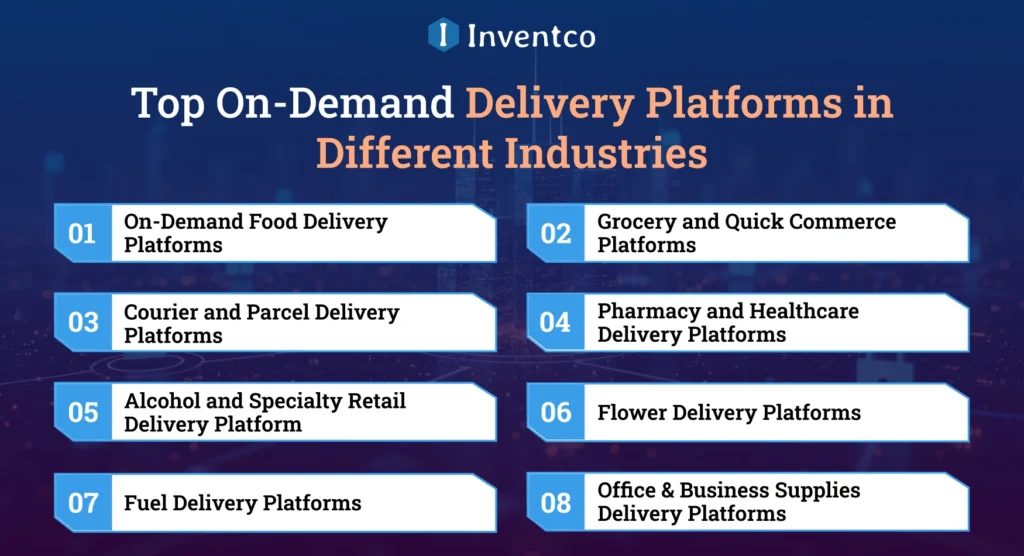
Top On-Demand Delivery Platforms in Different Industries
The on-demand delivery model has moved well beyond food. Here is how it plays out across the industries where it has taken firmest hold.
1. On-Demand Food Delivery Platforms
Leading on-demand food delivery platforms include DoorDash, Uber Eats, and Deliveroo. These applications deliver food from a wide variety of restaurants to their customers. They utilize large networks of delivery personnel and combine real-time order tracking, subscription services, and AI to create efficient delivery routes. All of these create faster delivery times and improved customer satisfaction.
2. Grocery and Quick Commerce Platforms
Instacart and Shipt design their business models to partner with existing stores and avoid physically owning a warehouse. At the same time, the newer fast-commerce companies like Gopuff and Getir operate ‘dark stores’ to facilitate delivery in under thirty minutes. This fast-fulfillment model is epitomized here, with AI-based inventory forecasting creating the greatest margins.
3. Courier and Parcel Delivery Platforms
Uber Direct, Stuart, and Careem Delivery offer flexible systems for parcel delivery catering to both businesses and individuals. They facilitate same-day, planned and last-mile delivery. These services include features to streamline logistics and optimize delivery systems using advanced tracking and flexible design.
4. Pharmacy and Healthcare Delivery Platforms
Amazon Pharmacy, Pharmacy2U, and Life Pharmacy simplify medication delivery through secure prescription management and doorstep fulfillment. These platforms prioritize compliance, identity verification, digital prescriptions, and temperature-controlled logistics to ensure safe, accurate, and timely delivery of healthcare products and prescription medicines.
5. Alcohol and Specialty Retail Delivery Platforms
Drizly, Majestic Wine and African + Eastern have created platforms for alcohol delivery that take legal compliance and customer convenience into consideration. Functions such as age verification, license verification and management, delivery scheduling, and payment security enable regulated product delivery while satisfying legal compliance in given locations.
6. Flower Delivery Platforms
The delivery of flowers for gifting has seen a huge transformation with the use of flower delivery platforms such as 1-800-Flowers, FTD, and Bloom & Wild. These platforms have made the delivery of flowers for an array of occasions, such as birthdays and even weddings, possible on the same day or scheduled for delivery at a later time.
They offer centralized ordering systems for florists and delivery tracking systems. Customers can personalize their orders with additional gifts. These platforms rely on the management of seasonal demands and optimal use of delivery systems to ensure that flowers are delivered in a timely and fresh state.
7. Fuel Delivery Platforms
Booster, Yoshi, and CAFU are examples of fuel delivery platforms that offer delivery of fuel to personal and commercial vehicles, as well as construction equipment. Customers schedule delivery via an app instead of driving to a fuel station. Fuel delivery companies have dashboards to schedule automated deliveries for their fleets. Success in this industry depends on system optimizations for delivery, legal compliance with regulations, and the management of safety and real-time logistics.
8. Office & Business Supplies Delivery Platforms
On-demand delivery apps like Staples, Office Depot, and Quill allow businesses to order office supplies and furniture with same-day or scheduled delivery. These platforms enable bulk orders, scheduled orders, and office supply inventories. Many of these delivery platforms allow businesses to set up a corporate account, which will simplify the order process. Automated inventory controls, demand forecasting, and AI technologies help supply delivery platforms serve all businesses by maintaining optimal stock levels and minimizing costs.
Comparison Table of On-Demand Delivery Platforms
Compare leading on-demand delivery platforms across industries, highlighting their core strengths, market focus, and ideal business use cases to understand what drives success in modern delivery app development.
| Platform | Industry Focus | Core Strength | Best Suited For |
| DoorDash | Food delivery | Largest U.S. market share, dense driver network | Restaurants scaling delivery volume |
| Instacart | Grocery delivery | Retailer partnerships, no warehouse ownership | Grocery chains entering e-commerce |
| Uber Direct | Courier/parcel | On-demand point-to-point logistics | Retailers needing white-label delivery |
| Amazon Pharmacy | Healthcare delivery | Compliance-first, verified fulfillment | Regulated, prescription-based delivery |
| Drizly | Alcohol delivery | Age verification and licensing logic | Specialty and regulated retail |
| 1-800-Flowers | Flower delivery | Nationwide florist network with same-day delivery | Florists and gifting businesses |
| CAFU | Fuel delivery | On-demand vehicle refueling with fleet management | Personal vehicles and commercial fleets |
| Staples | Office & business supplies | Extensive B2B catalog with scheduled delivery | Businesses managing workplace procurement |
The takeaway from this comparison is not which platform is “best”, it is that every category leader wins by solving one operational problem deeply rather than trying to be a generalist. That specificity is exactly what a founder should be designing toward.
Benefits of Using On-Demand Delivery Platforms
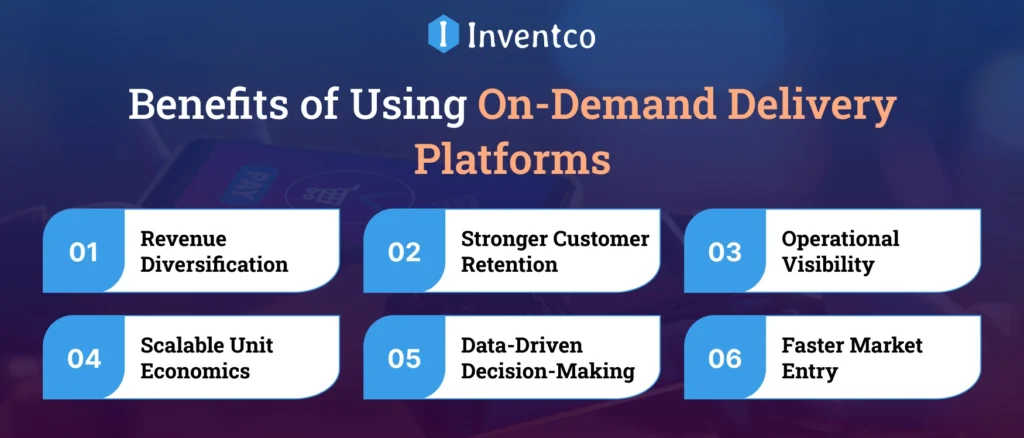
On-demand delivery platforms help businesses increase revenue, improve customer retention, optimize operations, reduce delivery costs, and scale faster with data-driven insights and efficient logistics management.
- Revenue Diversification: A delivery layer opens a new order channel without requiring additional physical locations.
- Stronger Customer Retention: Real-time tracking, saved preferences, and reorder flows increase repeat-purchase rates.
- Operational Visibility: Admin dashboards give founders live insight into order volume, driver performance, and delivery bottlenecks.
- Scalable Unit Economics: AI-based dispatch and route optimization reduce per-order delivery cost as volume grows.
- Data-Driven Decision-Making: Order history and delivery analytics inform inventory planning, pricing, and expansion decisions.
- Faster Market Entry: A well-built on-demand delivery solution lets a business compete with established players without years of physical infrastructure buildout.
Essential Technologies Behind Modern On-Demand Delivery Platforms
The right Mobile App Technology Stack determines whether a delivery platform can hold up under real order volume. Most competitive platforms are built on a common set of technical foundations:
- GPS and geolocation services for live tracking and accurate ETAs
- Cloud-based infrastructure (AWS, Google Cloud, or Azure) for elastic scaling during demand spikes
- AI and machine learning models for route optimization, demand forecasting, and dynamic pricing
- Secure, PCI-compliant payment gateway integrations supporting multiple payment methods
- Push notification and real-time messaging systems for order updates and support
- Role-based admin dashboards for order, inventory, and driver management
Choosing between native and cross-platform mobile app development frameworks also shapes performance, native builds generally offer better GPS accuracy and background-tracking reliability, which matters more in delivery apps than in most other categories. And because these platforms handle location data, payment details, and personal information at scale, Mobile App Security has to be designed in from the architecture stage, not patched on after launch.
Custom On-Demand Delivery Platform vs Ready-Made Solution
This is usually the first fork in the road for a founder evaluating build options, and it is worth deciding early, it affects budget, timeline, and how much control you retain over your own roadmap.
| Factor | Custom-Built Platform | Ready-Made Solution |
| Time to launch | 3-6 months depending on scope | 2-6 weeks |
| Upfront cost | $10,000-$100,000+ | Lower upfront, recurring license fees |
| Ownership of IP | Full ownership of code and logic | Limited or none, vendor-controlled |
| Customization | Fully tailored to the business model | Constrained to the vendor’s feature set |
| Scalability | Built to scale with the business | May hit vendor-imposed limits |
| Long-term cost | Lower over time at scale | Recurring fees compound with growth |
As a general rule, ready-made solutions make sense for validating demand quickly or running a lean pilot, while a custom build becomes the stronger investment the moment differentiated logistics logic, brand ownership, or long-term scale enters the conversation.
How to Choose the Right On-Demand Delivery Platform?
Before committing to a build path, it helps to work through the same questions Inventco walks founders through during discovery:
- What does the current app development trend in your specific industry suggest about customer expectations for same-day, sub-hour, or scheduled delivery?
- Which mobile app features are non-negotiable for launch versus which can wait for a later release?
- What is a realistic cost to build a mobile app for your specific scope, including driver-side and admin-side apps, not just the customer app?
- Should you launch with an MVP mobile app to validate demand before investing in a full feature set?
- What mobile app development challenges, such as driver supply, real-time routing accuracy, or payment compliance, are specific to your market?
Working through these questions with a technology partner before writing a single line of code is what separates founders who launch on budget from those who discover mid-build that their mobile app development process needs to restart from the requirements stage.
How to Build an On-Demand Delivery App?
Building a successful on-demand delivery app requires a clear strategy, the right technology, and a user-first approach. Follow these structured app development process for a scalable, secure, and high-performing delivery platform.
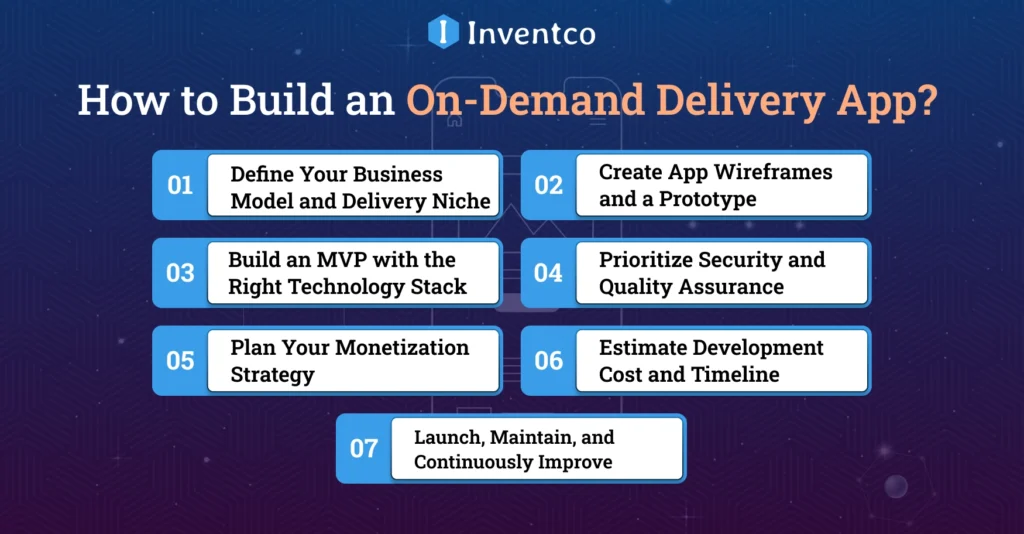
Step 1: Define Your Business Model and Delivery Niche
Identify what industry you want to serve, whether food, grocery, pharmacy, fuel, or courier services. Identify your target customers, how you will monetize your mobile app, and what your unique value proposition is. Once you identify these areas, you will be able to develop a mobile app that meets the needs of your customers and will be in demand in the marketplace.
Step 2: Create App Wireframes and a Prototype
The next step would be app wireframing to describe the user journey, the desired layouts, as well as the required core workflows. Once you are satisfied with the wireframes, design an app prototype to validate the stakeholder’s user experience and gather early feedback before investing in full-scale development.
Step 3: Build an MVP with the Right Technology Stack
Develop an MVP mobile app with user registration, order placement, payment, tracking, and notification features. When determining your mobile app tech stack, choose one that is scalable. The mobile app development frameworks you choose should allow for app development to grow (e.g., Flutter or React Native).
Step 4: Prioritize Security and Quality Assurance
Since your on-demand delivery platform will be handling customer orders and payment data, mobile app security is a top priority. Be sure to include tested, secure authentication and transaction methods in addition to mobile app testing to identify and eliminate bugs and streamline the user experience on all devices.
Step 5: Plan Your Monetization Strategy
Set on your monetization plan before your app goes live. Determine if revenue will come from your app via delivery commissions, a subscription, delivery surcharges, surge pricing, advertising, or a paid membership. If you have a good mobile app monetization plan, you will reach your target revenue while providing your delivery partners and your customers with good value for a long time.
Step 6: Estimate Development Cost and Timeline
Your cost to build a mobile app depends on the number of features, supported platforms, integrations, and overall complexity. Mobile app development trends like AI-based routing and predictive analytics are technologies that need to be considered to be competitive in the mobile app development process.
Step 7: Launch, Maintain, and Continuously Improve
After mobile app deployment, regularly monitor performance, release feature updates, and resolve issues to keep the platform reliable. Ongoing mobile app maintenance ensures long-term success, while understanding mobile app maintenance costs helps businesses budget for updates, security patches, performance optimization, and infrastructure scaling.
How Inventco Helped a Client Build Their On-Demand Delivery Platform
Inventco recently partnered with a regional retail brand looking to launch its own on-demand delivery platform rather than depend on third-party aggregators that were eating into margins with high commission fees.
Our team started with a lean MVP, customer app, driver app, and admin dashboard, built on a cloud-native stack with real-time GPS tracking and integrated payments. Within the first release cycle, the client was able to onboard delivery partners directly, cut third-party commission costs, and gain full ownership of customer data and delivery analytics for the first time.
The engagement reflected a pattern we see often: businesses don’t need every feature of a market leader on day one, they need a platform architected so that AI-based dispatch, loyalty programs, and multi-city expansion can be added without rebuilding the core system. That approach kept the initial build lean while protecting the client’s long-term roadmap.
Conclusion
The on-demand delivery category has moved past its early growth phase into a mature, competitive market, one where speed, transparency, and operational intelligence decide who wins repeat customers.
For founders and investors, that means the real decision isn’t whether to enter this space, but how: through a ready-made solution for fast validation, or a custom-built on-demand delivery platform designed to scale on your own terms. Either path benefits from a technology partner who has built and shipped these systems before.
If you’re evaluating how to build a mobile app for on-demand delivery or want a clearer picture of cost, timeline, and technology choices, Inventco’s team is ready to walk through your specific requirements.
FAQs
Q. How much does it cost to build an on-demand delivery platform?
Ans. A launch-ready on-demand delivery platform typically costs between $10,000 and $100,000+, depending on the number of apps (customer, driver, admin), geographic complexity, and whether AI-based dispatch is included.
Q. How long does it take to build an on-demand delivery app?
Ans. An MVP can typically launch in 8-12 weeks, while a full-featured platform with AI routing, multi-payment support, and analytics dashboards usually takes 4-6 months.
Q. Should we build custom or use a ready-made on-demand delivery solution?
Ans. Ready-made solutions suit fast market validation with limited customization. A custom build is the stronger choice once you need differentiated logistics logic, full IP ownership, or long-term scalability.
Q. What features are essential for an on-demand delivery platform at launch?
Ans. Real-time GPS tracking, secure payment integration, order and driver management dashboards, and push notifications are considered baseline requirements for any competitive launch.
Q. Which industries benefit most from on-demand delivery apps?
Ans. Food, grocery, quick commerce, courier and parcel services, pharmacy, and specialty retail have all shown strong, sustained adoption of on-demand delivery models.
Q. How does Inventco support on-demand delivery platform development?
Ans. Inventco handles the full delivery platform lifecycle, from MVP strategy and UX design to AI-based dispatch, payment integration, and post-launch scaling support, so founders can move from concept to a live, revenue-generating platform without re-architecting later.

Ajay Bhal
He is an on-demand app solutions expert with 11+ years of experience in business consulting and building scalable, user-centric digital products. He specializes in robust on-demand platforms across industries, combining technical expertise with business-focused strategy to deliver efficient, top notch solutions that drive growth and enhance user experience. You can connect with him on LinkedIn to follow insights.
![Fashion App Development: The Complete Guide for Brands and Startups [2026]](https://www.inventcolabssoftware.com/blog/wp-content/uploads/2025/07/Blog-Banner-10-1024x493.webp)