Cloud platforms have become the foundation of scalability, agility, and real-time decision-making as businesses move faster toward fully digital, data-driven operations. To stay competitive in a world that is becoming increasingly interconnected, businesses now rely on cloud platforms to handle everything from customer relationships to running their global infrastructure.
This has driven companies from old paradigms of running on-premises systems to flexible, cost-effective cloud environments that allow for instant access to data, seamless point integrations and accelerated innovation cycles. But selecting the right platform has become more than a technical choice, it’s now a strategic investment with direct effects on growth, performance and long-term ROI.
Two of the most dominant players in this space are Salesforce and AWS, two powerful but fundamentally different platforms. Both dominate the cloud domain but serve different purposes, making the choice between them pivotal for enterprises looking to leverage technology and transform their core aims.
In this blog, we will compare Salesforce vs AWS, analyze their core functionalities and use cases, and examine their pricing models to help you decide which platform is best suited for your business in 2026.
Key Takeaways
- The use case for these two applications differs. Salesforce is mainly focused on Customer Relationship Management (CRM), while AWS provides scalable cloud based infrastructure to build and deploy applications.
- Salesforce is the perfect solution for businesses that focus on customer engagement, sales automation, and more efficient workflows across marketing, service, and support operations.
- AWS is better suited for organizations that create their own applications, run data centers, and need scalable, cost-effective cloud environments to support global operations.
- While AWS uses pay-as-you-go pricing, which offers flexibility but also requires careful cost management and monitoring, Salesforce operates on a subscription-based pricing model.
- Salesforce enables business users to perform low-code customizations, whereas AWS provides developers with fine-grained technical control over the design and management of complex architectures.
- While both platforms are designed for scalability, Salesforce focuses on scaling customer operations, while AWS dynamically scales infrastructure resources to match business demand and workload.
- Rather than choosing between the two, many organizations integrate Salesforce with AWS to build a powerful end-to-end digital ecosystem for innovation and growth.
Market Statistics: Salesforce vs AWS
- The global cloud computing market is projected to grow from $1.29 trillion in 2025 to over $2.28 trillion by 2030, highlighting massive enterprise adoption worldwide.
- In 2026, the cloud market is expected to exceed $900 billion in annual value, driven by AI, data, and digital transformation initiatives.
- Around 29% of organizations spend over $12 million annually on cloud services, indicating a deep reliance on platforms such as AWS.
What Is Salesforce?
Salesforce is a client relationship management (CRM) solution. As SaaS innovation is facilitated in the cloud, Salesforce is used to support client database services, improve client connections and interactions, and aid business development. This technology is flexible and integrates well with several business frameworks. At the same time, it has been stated that CRM benefits organizations by offering the best solutions.
To keep it simple, Salesforce is a prominent CRM solution that delivers much better ROI when used effectively. You need to find a reputable Salesforce development company to help your business.
What Is AWS?
Amazon Web Services (AWS) offers Infrastructure-as-a-Service (IaaS) and Platform-as-a-Service (PaaS), and to a certain extent, Software-as-a-Service (SaaS). AWS has become the most popular cloud service provider, offering more than 100 services, including compute, storage, database, and application development.
Salesforce vs AWS: Core Difference Explained
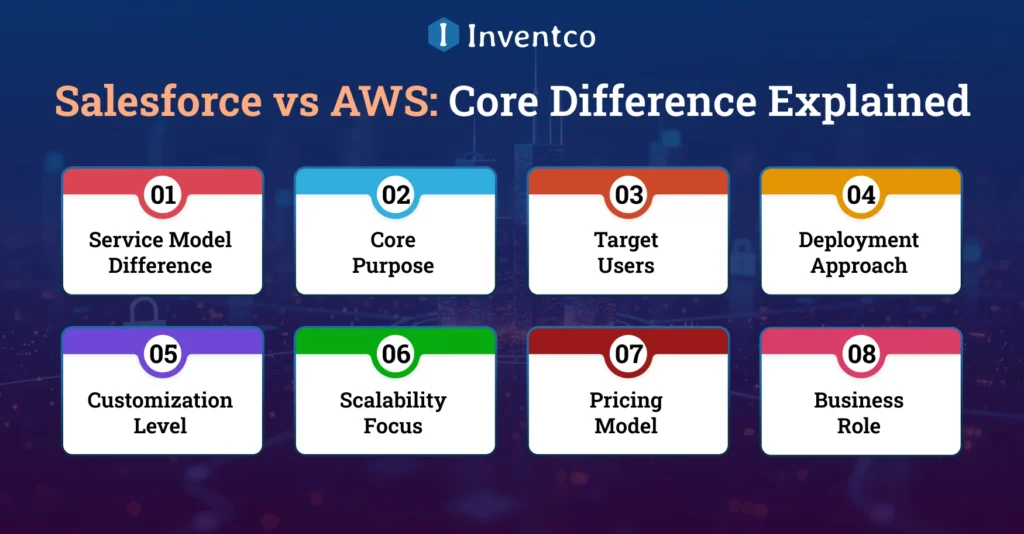
To make the right choice between Salesforce and AWS, one must be clear about their core purposes, architecture, and business value. Though both are leaders in the cloud, they are solving completely different issues across modern digital ecosystems.
1. Service Model Difference
Salesforce operates as a Software-as-a-Service (SaaS) platform delivering ready-made business applications, while AWS primarily offers Infrastructure-as-a-Service (IaaS), enabling companies to build, deploy, and manage applications using scalable cloud infrastructure and platform services.
2. Core Purpose
While Salesforce is made for customer relations, workflow automation, and engagement across sales, marketing, and service teams, AWS is targeted towards providing computing power, storage systems, networking as well as the tools required to build and run digital applications.
3. Target Users
Salesforce is best suited for business professionals, including sales teams, marketers and customer support staff, while AWS is designed for developers, IT professionals and system architects who build, manage and scale applications and infrastructure.
4. Deployment Approach
Even though AWS has something called partner applications, partner firms build applications on top of AWS, the advantage with Salesforce is while they have a wide range of tools and options, their core focus remains on building both pre-built applications quickly to suit customer needs without heavy developer capabilities.
5. Customization Level
Salesforce enables low-code/no-code customization for easy workflow/process tailoring, while AWS provides deep customizability through programming, allowing complete control over infrastructure, architecture, and application behavior.
6. Scalability Focus
Salesforce allows organizations to expand their customer-facing operations and business processes as they grow while AWS elastic scalability is for infrastructure, which gives businesses the ability to scale computing resources up or down automatically, according to real-time demand and usage.
7. Pricing Model
Salesforce uses subscription-based pricing and typically charges per user per month creating predictable costs whereas in AWS usage patterns are the basis of a pay-as-you-go cost model where businesses are billed only for what they really consume.
8. Business Role
While Salesforce fuels customer interaction, sales expansion, and operational effectiveness; AWS undergirds digital infrastructure, enabling application development, data processing, as well as scalable technology ecosystems for companies around the world.
Salesforce Cloud vs AWS: How They Compare
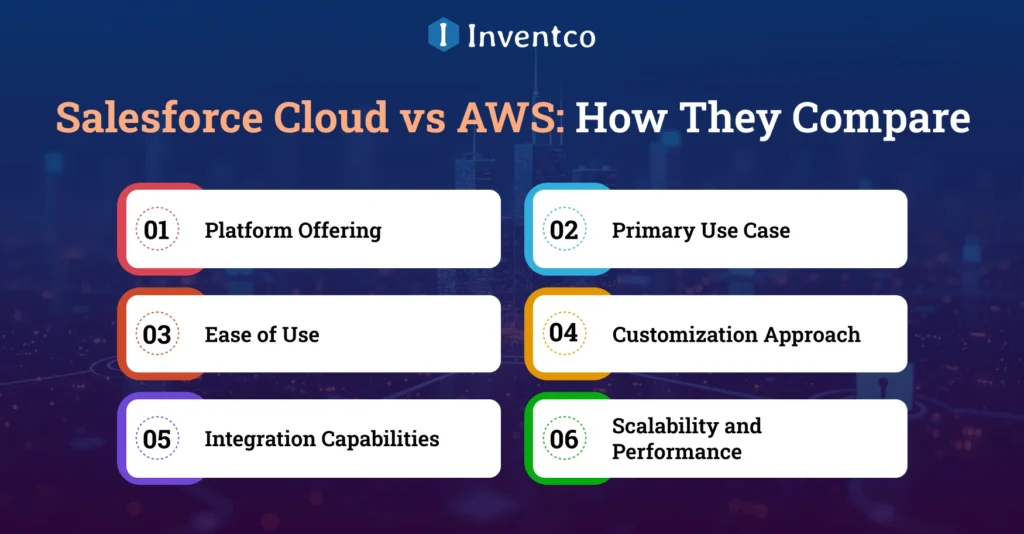
Both Salesforce Cloud and AWS operate on different levels of the cloud ecosystem, but both are necessary for modern business. By comparing them, organizations can better align their technology spend to operational objectives and scalability requirements over time.
1. Platform Offering
Salesforce Cloud offers integrated business applications (e.g., Sales Cloud, Service Cloud, Marketing Cloud), and AWS covers a wide line of infrastructure and platform services including compute, storage, databases and analytics tools.
2. Primary Use Case
Salesforce Cloud allows users to manage customer relationships, automate workflow, and improve customer service while AWS is designed for high scalability and performance in the same products that can be deployed on boats, websites, and enterprise systems.
3. Ease of Use
Salesforce Cloud is more user-friendly and non-technical with NavTags, which requires very little coding knowledge to get started, on the other hand, AWS needs a bit of tech-savvy since users need to configure their infrastructure, manage services and deployments manually or through development tools.
4. Customization Approach
Salesforce Cloud focuses on low-code, configuration design tools that are business-use-friendly, while AWS allows programmers to dig deep into applications and architecture-level flexibility for complete control over their product offering.
5. Integration Capabilities
Salesforce Cloud seamlessly integrates with CRM tools, third-party applications and enterprise systems whereas AWS takes it a level deeper, helping you integrate databases, field applications, APIs and complex cloud-native environments.
6. Scalability and Performance
From Salesforce Cloud automating business processes and managing channel partners to AWS providing infrastructure scalability, no other cloud provider can beat the scale at which you can run compute & embedded high skilled labor workloads around the world today.
When to Choose Salesforce and AWS Explained?
When deciding between Salesforce and AWS, the best choice depends on your business needs, technical requirements, and growth strategy. Rather than think of them as competing silos, it’s more productive to see where they each fit into your digital ecosystem.
1. Choose Salesforce When
You need a powerful CRM platform
If your main focus is customer relationship management, lead tracking and bettering sales pipelines Salesforce has a comprehensive out of the box solution tailored for business teams.
Customer experience is your top priority
Salesforce likes to call themselves the “customer success platform” because their products help consolidate customer information, automate interactions, and provide tailor-made experiences through sales, marketing and customer support channels.
You want faster deployment with minimal coding
Salesforce enables businesses to implement and customize the solutions in a quick span with low-code or no-code capabilities, making them less dependent on intensive technical resources.
Your focus is on business process automation
Salesforce simplifies workflows, automates mundane tasks and enhances operational efficiency across functions.
2. Choose AWS When
You need scalable cloud infrastructure
AWS suits the businesses in need of computing power, storage and networking application building and running at scale.
You are building custom applications or platforms
If your business is based on creating customized digital solutions, AWS offers the extensive resources required for both development and deployment.
You want cost flexibility with usage-based pricing
AWS’s consumption-based payment model enables companies to reduce costs by only paying for the resources they use.
You require high-performance and global scalability
It is widely used for building and hosting small to large scale applications with real time data streaming, high availability and global deployments.
For a lot of modern businesses, the wisest move is not to pick one or the other. It is a SaaS or cloud-based solution that uses Salesforce (customers) and AWS (infrastructure), making it flexible, scalable, and futuristic.
Note: If you’re exploring innovative Salesforce solutions, this blog shares powerful salesforce app ideas to help streamline operations and boost productivity.
Why Choose Inventco for Salesforce and AWS Solutions?
The right cloud strategy is just the first half of the journey; the second half lies in choosing a technology partner that can successfully implement what you have planned. The power of both technologies lies in our tight-knit business unit, Inventco with specialized depth in Salesforce and AWS working collaboratively to drive not just solutions but results.
Our team has had hands-on experience in CRM implementation, cloud architecture, and enterprise-grade integrations. Whether you’re working in Salesforce to engage customers or on AWS to create a scalable routing infrastructure, we make sure each solution supports your business objectives defining goals, performance expectations and long-term strategy.
What makes Inventco stand out is our approach to practical execution and business impact. We don’t just suggest platforms—we help utilize them the right way with customized strategies, planned integrations and performance-driven development. Each step, from initial consultation to deployment and ongoing support, is supported by proven methodologies as well as industry best practices.
Inventco empowers businesses to simplify, streamline processes and confidently drive digital transformation with its robust quality assurance, transparency and innovation focus.
Conclusion
When to use Salesforce vs AWS really comes down to your business goals and vision for the long-term. Salesforce is the best tool for managing customer relationships, automating workflows, and driving revenue growth while AWS provides the infrastructure necessary to build, deploy and scale modern applications.
Instead of considering them as rivals, businesses need to consider them as complementary products. Salesforce is what drives increased customer engagement, while AWS is what powers the back end systems that enable scale and innovation.
For the vast majority of organizations, using both shapes a balanced ecosystem that’s ready for whatever’s next. The businesses that seek the appropriate implementation strategies can successfully reap gains from simplicity, drive revenue enhancement and sustain growth as they grapple with a more competitive digital environment.
FAQs
Q1. What is the main difference between Salesforce and AWS?
Ans. Salesforce is a SaaS platform focused on customer relationship management, while AWS is a cloud infrastructure provider offering computing, storage, and development services for building and running applications.
Q2. Which is better for businesses: Salesforce or AWS?
Ans. It depends on your business needs. Salesforce is better for managing customers and sales processes, while AWS is ideal for building scalable applications and managing infrastructure.
Q3. Can Salesforce and AWS be used together?
Ans. Yes, many businesses use Salesforce for CRM and AWS for backend infrastructure. Integrating both platforms helps create a scalable and efficient digital ecosystem.
Q4. Is Salesforce built on AWS?
Ans. Salesforce primarily runs on its own infrastructure but also leverages public cloud providers like AWS in certain regions to enhance scalability and performance.
Q5. Which platform is more cost-effective: Salesforce or AWS?
Ans. Salesforce uses a subscription-based pricing model, while AWS follows a pay-as-you-go approach. AWS can be cost-effective for flexible usage, while Salesforce offers predictable pricing for CRM needs.
Q6. Do I need technical expertise to use Salesforce or AWS?
Ans. Salesforce requires minimal technical expertise due to its low-code environment, whereas AWS typically requires skilled developers or IT professionals to manage infrastructure and services.

Sandeep Agrawal
Sandeep Agrawal is the visionary CTO at Inventco, bringing innovation to life through his technical expertise. With a passion for cutting-edge technologies, Sandeep leads the team in developing robust solutions. His dedication and continous efforts to pushing the boundaries of what’s possible defines his role as a transformative and innovative force in the tech industry.